
English Intent
At Knowsley Junior School we recognise the crucial importance of a high quality education in English. It is essential for children to speak, write and read fluently, in order to effectively communicate with and understand others. Mastering the skills of language is crucial in order to access the full national curriculum and to participate fully in society. Improved performance in reading, writing and spoken language will enable our pupils to express their thoughts and ideas more fluently and accurately. This will also help them to deal more successfully with other curriculum subjects, while enriching their lives beyond school. The teaching and learning of language skills are, therefore, given a high priority at Knowsley Junior School and, where possible, the creative curriculum and ICT will be used as tools to support and enhance learning.
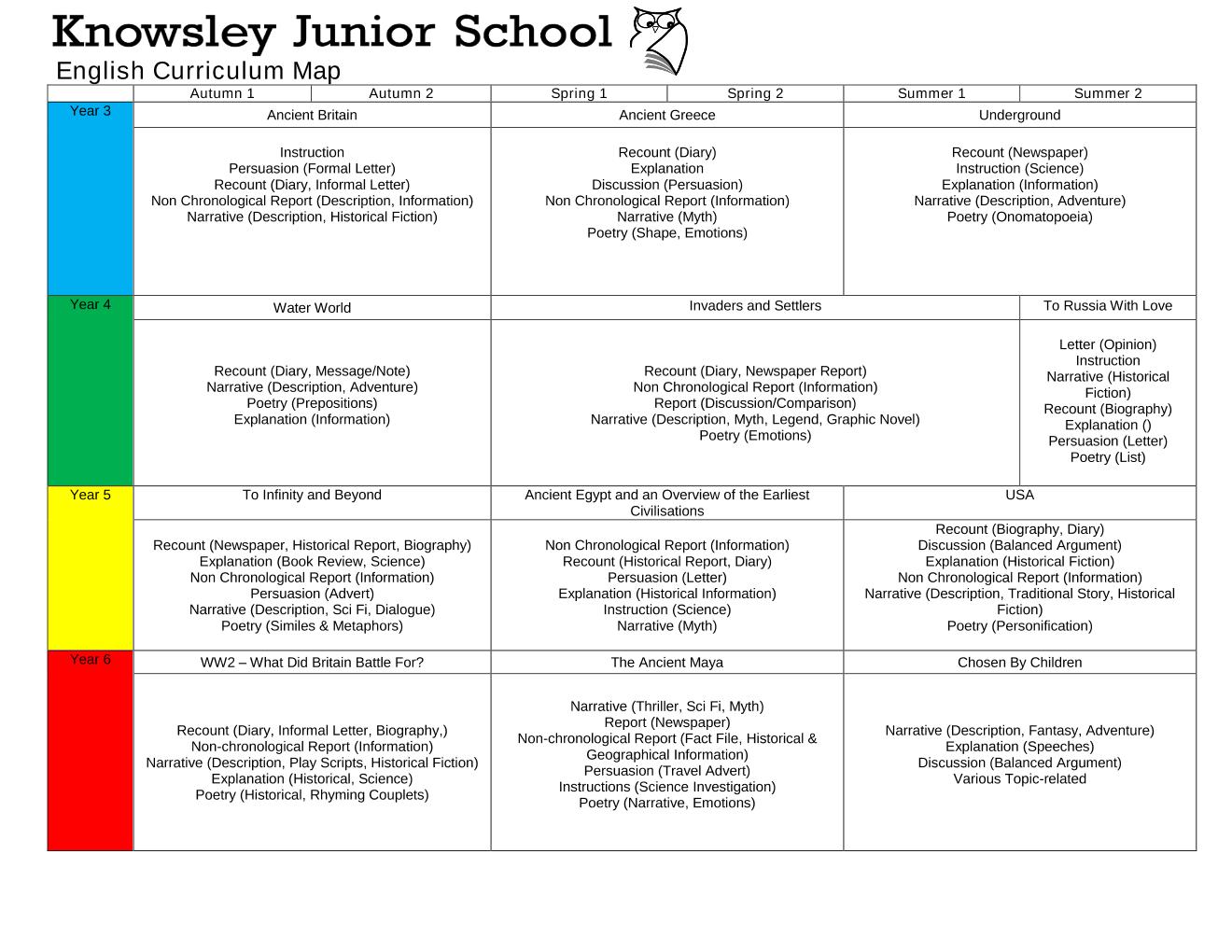
English Curriculum Map
Please select the document below.

|
English Curriculum Map | [pdf 101KB] |

|
Implementation: English Skills and Knowledge
From Year 3 to Year 6, pupils are taught English through an integrated creative curriculum, within their classes. English opportunities are carefully planned and are closely linked to each year group’s termly topic long-term plans, in order for pupils to make links to the real world and to see how essential English is in their everyday lives (also see Curriculum Policy). Clear lesson objectives and success criteria are routinely shared (or created) with pupils, and working walls support learning in classrooms. Pupils are encouraged to use ICT as a resource for learning (particularly in their independent learning at home), when appropriate.
Careful planning and differentiation ensures that all pupils receive high quality teaching and appropriate support, in order for them to reach their full potential. Pupils of all abilities may receive additional support, where necessary, outside of curriculum time (e.g. via 1:1 or focus group interventions, booster groups, clubs, etc), in order for them to achieve personal targets and to reach their full potential. Pupils with SEND, EAL and new arrivals may also be withdrawn in order to receive interventions that focus on their specific individual needs and enable them to access the curriculum at their own level.
Development of quality speaking, listening and thinking skills is a focus throughout school. Teachers plan for frequent and varied opportunities throughout the curriculum, for example, P4C (Philosophy for Children), SMSC, drama, assemblies, Book Club, pupil voice (including School Council and Eco Council), talk partners, group work, etc. Our creative curriculum enables pupils to make links in all of their learning.
A love of reading and literacy is developed throughout school in many ways, for example, through topic-linked core texts, book clubs, regular book fairs and competitions, class libraries and reading challenges, whole school nonfiction lending library and loyalty scheme, entrance hall reading shelf, author visits, etc. Reading is taught weekly in a whole class setting, known as Book Club. Each year group focuses on carefully chosen, topic related, fiction core texts (each pupil has access to their own copy). The texts provide a high level of challenge (of themes, use of language, grammar and vocabulary) for all pupils, and teachers ensure individuals access the texts at their own level. Additional focussed interventions may also be used to provide support for all abilities. Supplementary texts (including non-fiction, poetry and picture books, etc) are also embedded into the curriculum to inspire and develop writing opportunities. All texts provide many opportunities for in-depth, high-quality discussion, leading to developed reading skills, comprehension and vocabulary, which in turn feed directly into writing. Book Club promotes a love of reading, books and literacy. In order to further assess and monitor pupils’ progress and to ensure wide coverage of genres, regular additional comprehension lessons supplement Book Club sessions.
Each class has its own fiction lending library and pupils are encouraged and supported to choose challenging books to read in school and at home. Pupils read frequently in ERIC time (Everyone Reading in Class) and are encouraged to practise their reading skills and fluency independently, in pairs or with the support of an adult.
Throughout KS2, pupils are provided with weekly opportunities to write independently (throughout the curriculum) and regular extended pieces of writing are also produced. Where writing is linked to the topic, a best copy is recorded in pupils’ topic books. Pupils are taught the value of the planning, revising and evaluation as essential parts of the writing process, and a number of lessons, incorporating discussion, note taking, research (including homework and independent learning), redrafting and editing may contribute to producing a final piece of independent writing.
Pupils are taught that writing can take many forms, and teachers plan carefully for these varied and numerous opportunities. Children are taught that the style of writing (including handwriting) may vary depending on its purpose, and although writing in workbooks, on white boards, as part of group work, etc, may not be formally marked, it will be checked and monitored as it is an essential part of the writing process.
Following a piece of independent writing, reflection and editing time is encouraged (and often timetabled). Pupils reread, edit and improve their own work (the level of independence in editing increases throughout KS2). Editing is a skill that needs to be taught and children are given guidance and opportunities to reflect upon, discuss (with a partner or in a writing conference with an adult) and improve their work using dictionaries, thesauruses, editing walls, etc.
Spelling is taught regularly and may be taught in short sessions or full lessons. Teachers focus on spelling patterns, rules, root words and their meanings and etymology. Repetition is essential to embed new learning and teachers reinforce spelling in all curriculum areas. Word banks, spelling rules and tricky spellings may be displayed around classrooms and/or provided for individuals as needed. Where spelling activities are set as homework, pupils focus on reinforcing learning from school; learning word lists specifically for spelling tests is discouraged. Through careful planning, teachers endeavour to ensure that pupils understand the importance of punctuation and grammar, and their direct links to writing. Where possible, punctuation and grammar lessons precede and feed directly into weekly independent writing lessons. SPaG is a constant focus in all writing and is continually reinforced in all curriculum areas.
Our Handwriting Policy is taught throughout school. We give pupils the freedom to choose their own style and writing implement when working on white boards or when writing for their own personal use (e.g. in workbooks, for note taking, when planning writing, etc), and joined, legible handwriting is the expected standard in all formal books.
|
|
English Skills and Knowledge in Year 3 | [pdf 357KB] |
|
|
|
English Skills and Knowledge in Year 4 | [pdf 192KB] |
|
|
|
English Skills and Knowledge in Year 5 | [pdf 179KB] |
|
|
|
English Skills and Knowledge in Year 6 | [pdf 347KB] |
|
Impact
The impact on our children is clear: progress, sustained learning and transferable skills. With the implementation of the writing journey being well established and taught thoroughly throughout school, children are becoming more confident writers and by the time they are in upper Key Stage 2, most genres of writing are familiar to them and the teaching can focus on creativity, writer’s craft, sustained writing and manipulation of grammar and punctuation skills. As all aspects of English are an integral part of the curriculum, cross-curricular writing standards have also improved and skills taught in the English lesson are transferred into other subjects; this shows consolidation of skills and a deeper understanding of how and when to use specific grammar, punctuation and grammar objectives. We know that we have equipped children to move on from us to further their education and know that their creativity, passion for English and high aspirations travel with them and continue to grow and develop as they do.
Children will leave Knowsley Junior School reading, writing, speaking and listening with confidence, fluency and understanding using a range of strategies to take responsibility for their own learning. Through a variety of topics, vocabulary will be stretched and the importance of suitable and technical vocabulary encouraged.

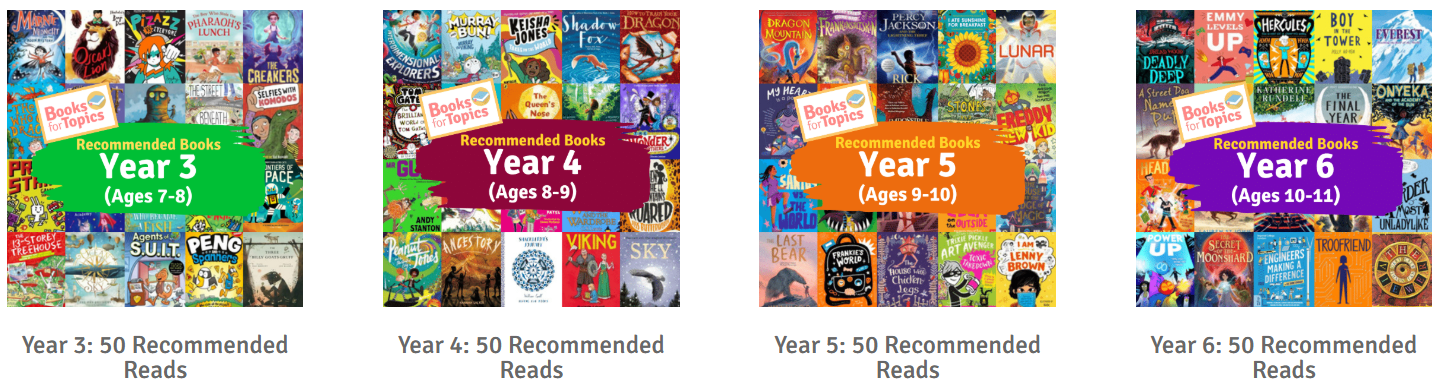
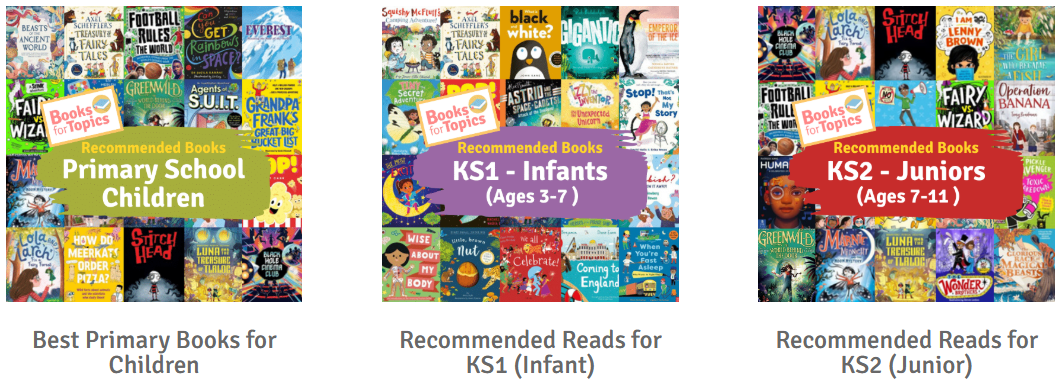


English Learning Resources
 |
KS2 English Resources |