
Religious Education Intent
The principal aim of Religious Education at Knowsley Junior School is to explore what people believe and what difference this makes to how they live, so that pupils can gain the knowledge, understanding and skills needed to handle questions raised by religion and belief, reflecting on their own ideas and ways of living. We follow the Oldham agreed RE syllabus Believing and Belonging.
The RE curriculum is representative of the diverse community that our children live in and is highly focussed on the British Values, in particular, tolerance. This will help our young people grow into well informed, reflective and open adults.

Religious Education Curriculum Map
Please select the document below.

|
RE Curriculum Map | [pdf 309KB] |

|
Implementation: RE Skills and Knowledge
The threefold aim of RE elaborates the principal aim and puts the purpose of the subject into action. We follow Oldham's agreed syllabus which aims to ensure that all pupils:
Make sense of a range of religious and non-religious beliefs, so that they can:
-
Identify, describe, explain and analyse beliefs and concepts in the context of living religions, using appropriate vocabulary.
-
Explain how and why these beliefs are understood in different ways, by individuals and within communities.
-
Recognise how and why sources of authority (e.g. texts, teachings, traditions, leaders) are used, expressed and interpreted in different ways, developing skills of interpretation.
Understand the impact and significance of religious and non-religious beliefs, so that they can:
-
Examine and explain how and why people express their beliefs in diverse ways.
-
Recognise and account for ways in which people put their beliefs into action in diverse ways, in their everyday lives, within their communities and in the wider world;
-
Appreciate and appraise the significance of different ways of life and ways of expressing meaning.
Make connections between religious and non-religious beliefs, concepts, practices and ideas studied, so that they can:
-
Evaluate, reflect on and enquire into key concepts and questions studied, responding thoughtfully and creatively, giving good reasons for their responses.
-
Challenge the ideas they study, and consider how these ideas might challenge their own thinking, articulating beliefs, values and commitments clearly in response.
-
Discern possible connections between the ideas studied and their own ways of understanding the world, expressing their critical responses and personal reflections with increasing clarity and understanding.
|
|
RE Skills and Knowledge in Year 3 | [pdf 144KB] |
|
|
|
RE Skills and Knowledge in Year 4 | [pdf 142KB] |
|
|
|
RE Skills and Knowledge in Year 5 | [pdf 153KB] |
|
|
|
RE Skills and Knowledge in Year 6 | [pdf 224KB] |
|

Special Educational Needs: Religious Education
Please select the document below.
|
|
SEND in RE | [pdf 440KB] |
|
Impact
Children demonstrate their ability in RE in a variety of different ways, without an explicit writing or English focus. Teachers will assess children’s understanding by making informal judgments during lessons, based on a child’s critical thinking, questioning, reflection and comparison skills.
At the end of a whole unit of work, the teacher makes a summary judgement about the work produced using the RE skills and knowledge sheet which, when completed, indicates the children who have not met, met or exceeded age related expectations for that term. We use this teacher assessment as a basis for assessing the progress of the child, and we pass this information on to the next teacher at the end of the year.
Parental right of withdrawal from RE
'In the UK, parents still have the right to withdraw their children from RE on the grounds that they wish to provide their own RE. This provision will be the parents’ responsibility. This right of withdrawal exists for all pupils in all types of school, including schools with and without a religious designation. Students aged 18 or over have the right to withdraw themselves from RE. Parents also have the right to withdraw their child from part of RE, and can do so without giving any explanation.' (NATRE, 1998)
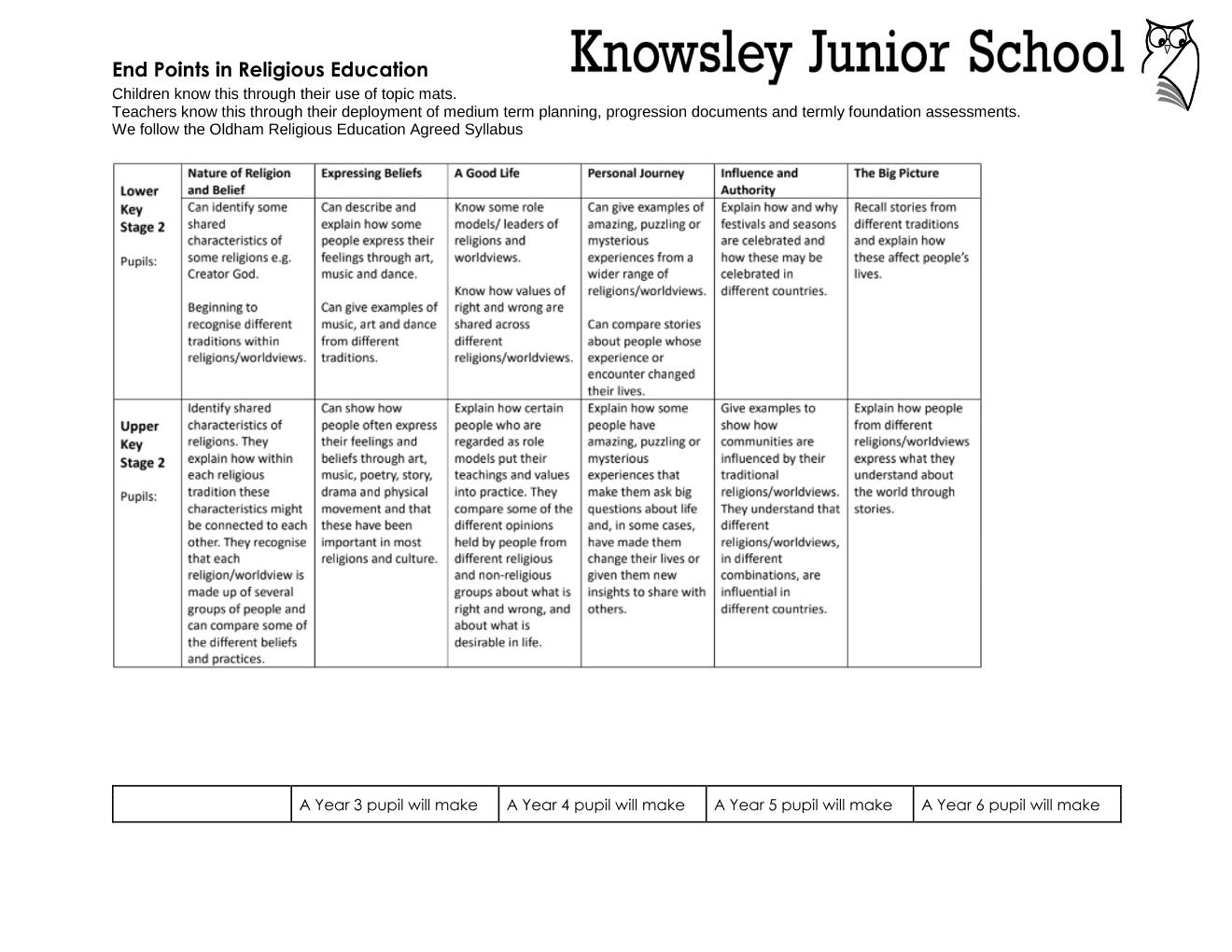
How we know that progress is being made?
Please select the document below.
|
|
RE End Points | [pdf 221KB] |
|
Religious Education and Collective Worship
The Standing Advisory Council on Religious Education (SACRE) advises on Oldham’s agreed syllabus for Religious Education, publishes an annual report, conducts regular meetings, monitors the quality and provision of Religious Education in all maintained and voluntary controlled schools and receives complaints in relation to Religious Education and collective worship.
Believing and Belonging is the new RE syllabus for Oldham. It will run from 2025-2030.
 |
Oldham Agreed Syllabus |