
Science Intent
Our science curriculum aims to develop children’s knowledge and understanding of the world around them through high-quality, engaging learning experiences. It builds essential scientific knowledge and working scientifically skills, encouraging curiosity, questioning, and a sense of wonder about natural phenomena. Science is taught through exciting, well-sequenced topics that inspire pupils and help them make sense of the world. Our curriculum consolidates and extends learning from KS1, with a strong emphasis on practical investigation, fair testing and the use of scientific vocabulary. Children learn about significant scientists and how scientific ideas have developed over time.
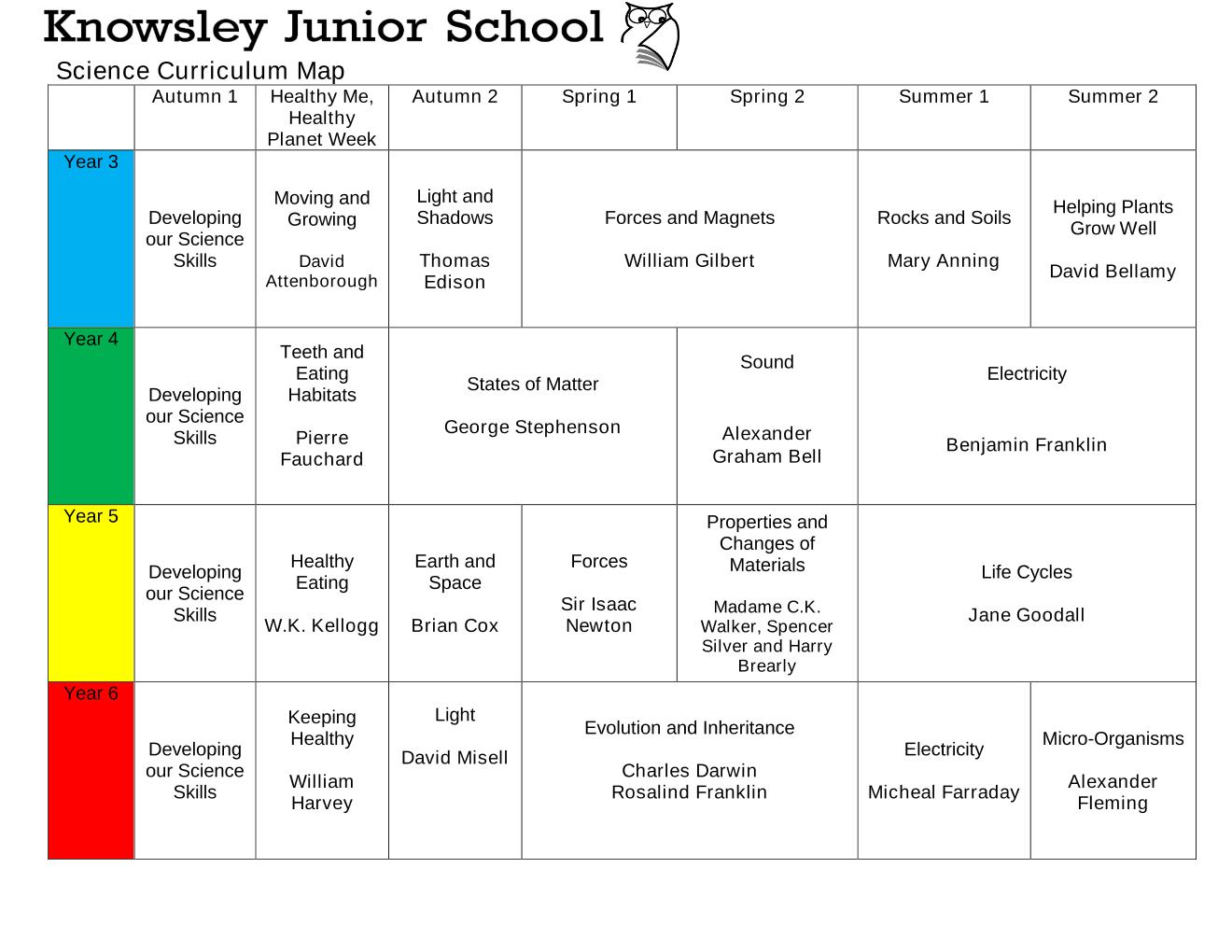
Science Curriculum Map
Please select the document below.

|
Science Curriculum Map | [pdf 38KB] |

|
Implementation: Science Skills and Knowledge
Year 3 begin with Developing our Science Skills before moving into the topics Moving and Growing and Light and Shadows. Children learn about nutrition, skeletons and muscles, the need for light to see, how shadows are formed and patterns in shadow size. In the spring term, they study Forces and Magnets, comparing movement on surfaces, magnetic and non-magnetic materials and magnetic poles. In the summer term, the focus is Rocks and Soils and Helping Plants Grow Well, where children compare rocks and fossils, learn how soil and fossils form, explore plant parts and functions, and investigate what plants need to grow.
Year 4 also start with Developing our Science Skills, Teeth and Eating, Habitats and States of Matter. They learn about the digestive system, teeth functions, food chains, grouping living things, and changes of state including evaporation and condensation. In the spring term, they study Sound, exploring how sounds are made by vibrations, pitch, volume, and how sound travels. In the summer term, they cover Electricity, constructing simple circuits, identifying components, and learning about conductors and insulators.
Year 5 continue to develop their Science Skills, Healthy Eating and Digestion and Earth and Space. Children identify organs and the digestive system while learning about the solar system, planets, the moon, day and night and seasons. In the spring term, they study Forces and Properties and Changes of Materials, investigating gravity, friction, air and water resistance, reversible and irreversible changes, and separating mixtures. In the summer term, the topics are Life Cycles and Animals including Humans, covering plant and animal life cycles, human development, and milestones from conception to death.
Year 6 consolidate their Science Skills, Keeping Healthy and Light. They learn about the circulatory system, the impact of diet and lifestyle, how light travels in straight lines, reflection and shadows. In the spring term, they study Evolution and Inheritance, exploring traits, adaptations, fossils, natural selection and selective breeding. In the summer term, they cover Electricity and Micro Organisms, investigating circuit components, brightness and volume in circuits, and classifying living things including microorganisms.
Throughout all topics, children develop their ‘working scientifically’ skills - planning enquiries, making predictions, setting up fair tests, recording data, drawing conclusions, and evaluating. Learning is recorded to a high standard in books, where teachers integrate literacy and mathematical skills. Pupils are frequently challenged to deepen their scientific thinking and use increasingly precise scientific language.
|
|
Science Skills and Knowledge in Year 3 | [pdf 158KB] |
|
|
|
Science Skills and Knowledge in Year 4 | [pdf 157KB] |
|
|
|
Science Skills and Knowledge in Year 5 | [pdf 149KB] |
|
|
|
Science Skills and Knowledge in Year 6 | [pdf 159KB] |
|
Impact
Science is assessed every term using the foundation assessment proforma, which identifies children working at, above, or below age-related expectations and informs teacher planning. Progress in science is measured by children’s growing ability to work scientifically, their deepening understanding of key concepts and their confidence in using scientific vocabulary and evidence to explain ideas. As children move through the school, their investigations become more complex, they take greater ownership of planning and evaluating enquiries and they become increasingly able to make links across topics and apply their knowledge to new situations.
Children leave Knowsley Junior School as confident, curious scientists who can think critically and communicate their ideas clearly.
How we know that progress is being made
- Each term, teachers report on attainment using statements from the National Curriculum. This data is analysed by the subject lead to ensure all children make progress.
- Science books and practical work are regularly scrutinised by leaders and the subject lead to check that progress is evident in both knowledge and skills.
- Lesson observations and pupil discussions show increasing complexity and independence in scientific thinking as children move through year groups.
- High achievers are identified and supported to ensure they continue to make strong progress.
Children at Knowsley Junior School develop secure scientific knowledge, a wide scientific vocabulary, and the skills needed to explore and understand the world around them.
The Science Quality Mark covers the following areas:
- Science Leadership - vision and value, development goals, monitoring and professional development for subject leadership;
- Science Teaching - CPD, teaching strategies, resources;
- Science Learning - science enquiry, assessment, science capital;
- Wider Opportunities – linking science with other subjects and whole school initiatives, curriculum enrichment.


Science Learning Resources
 |
Science Learning Resources |