

Our Team 2026-27
Teachers: Mrs F. Stewardson and Mrs A. Anderson
Teaching Assistants: Mrs A. Pritchard and Mrs A. Harrott
Class Governor: Andy Hulmes
Welcome to Year 6
Dear Parent/Guardian,
Year 6 is the final year at Knowsley Junior School and a very important one too! The children learn to become more independent in preparation for secondary school. They will have planner, which they are expected to use daily. These should be checked and signed weekly, by a parent. It is during this year that the Key Stage 2 SATs take place, so the children need to continue to work very hard.
In the autumn term, our topic is World War 2 – What Did Britain Battle For? Through our creative curriculum, all of the children’s work will be based around significant events which took place during the Second World War, with a particular focus on the Battle of Britain. As with all our themes, if you have any resources that we could share with the children, we would be grateful if you could send them in.
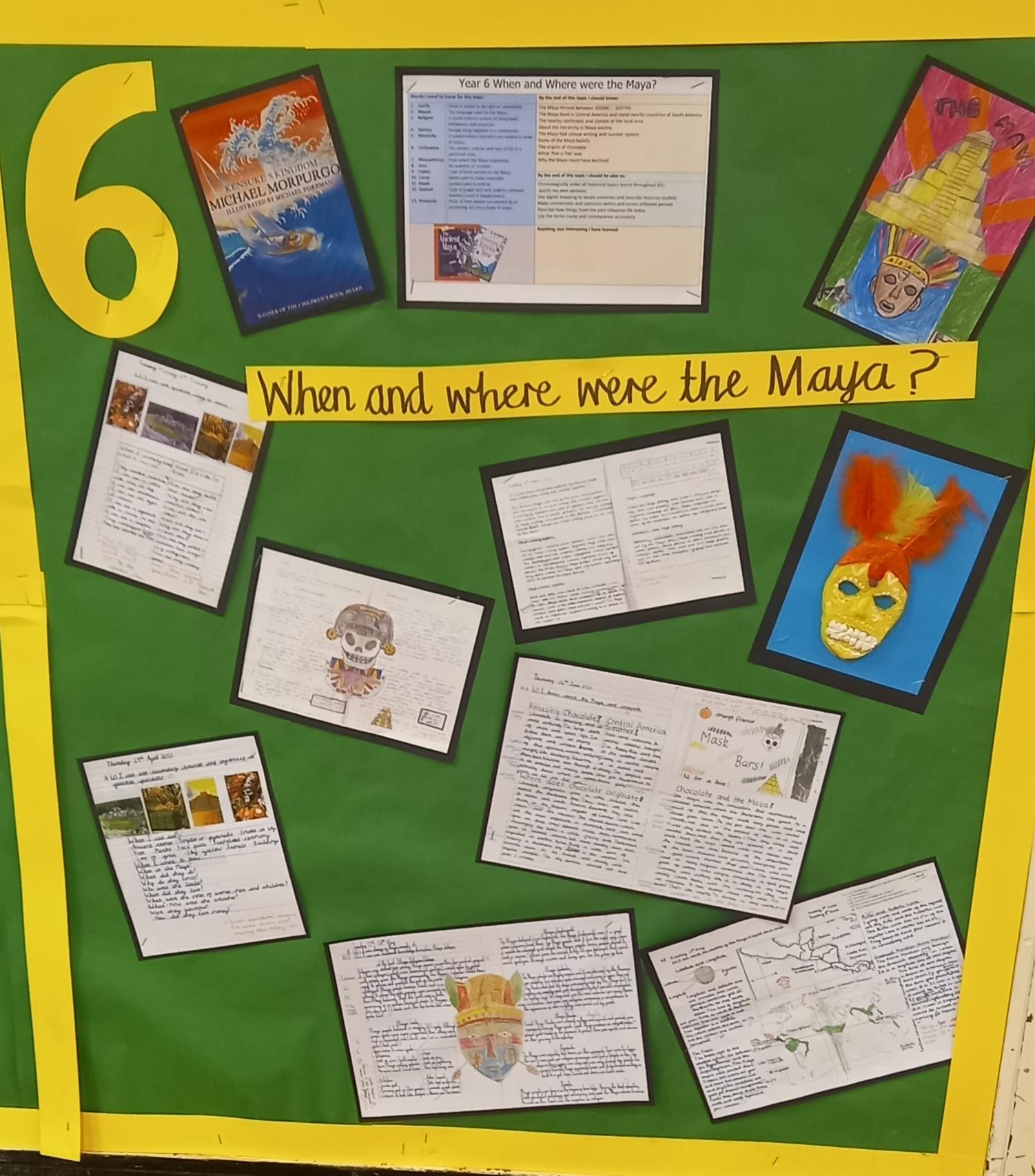
In spring, we will learn about the Maya, an ancient South American civilisation. We are very excited about our curriculum and know that the children will share our enthusiasm.
The children will sit their Key Stage 2 SATs during the week beginning Monday 10th May 2027. Your child’s attendance is of paramount importance. After SATs, we allow the children to choose their own topics within their classes and this always brings much enjoyment.
The summer term is spent preparing your child for their transition to secondary school, building their confidence and independence for this huge step. The year will end with our annual Year 6 Presentation Evening, a night of celebration, entertainment and lots of fond memories.
Here's looking forward to a challenging, action packed and fun-filled year!
Your Year 6 teachers.

Welcome to Year 6
Please select the document below.

|
Welcome to Year 6 Presentation September 2026 | [pdf 719KB] |

|


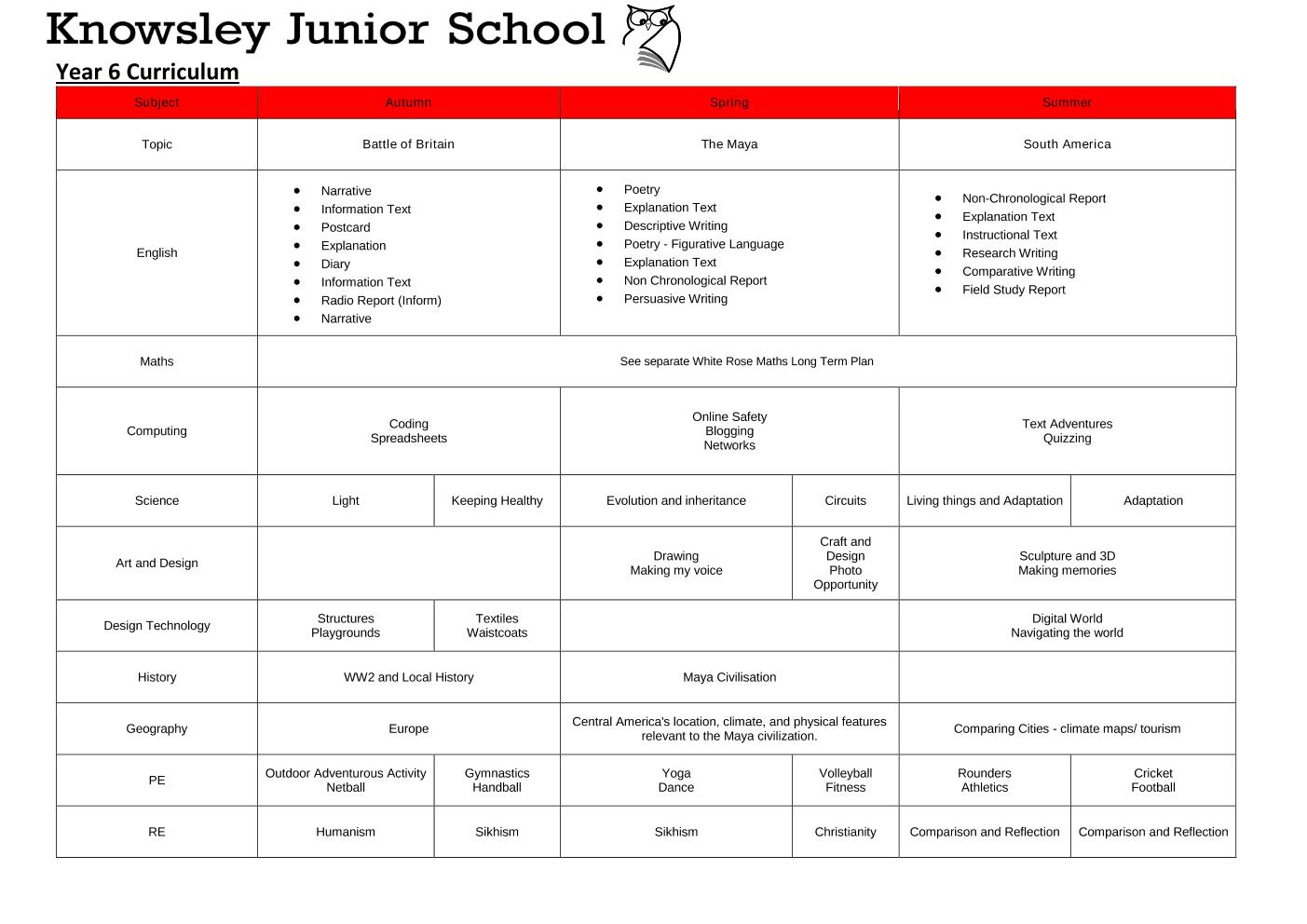
Annual Curriculum Planning
Please select the document below.
|
|
Year 6 Curriculum Map | [pdf 338KB] |
|
Autumn Term First Half 2026

Autumn Term Second Half 2026
TBA

Autumn Term Home Learning Challenges
At Knowsley Junior School, we know that children achieve their best when home and school work together. This year, we have developed our approach to home learning, informed by research from the Education Endowment Foundation (EEF).
Our home learning activities are designed to be purposeful, manageable and enjoyable, reinforcing classroom learning, encouraging regular reading and helping children practise key skills. We encourage children to complete activities little and often, developing their confidence, independence and positive learning habits.
Please encourage your child to take part and use their school planner to record, share and celebrate their learning at home.
Learning happens everywhere. By working together, we can help our children develop the knowledge, skills and confidence to thrive.

Reading Home Learning Challenges
- Reading Response Journal – after reading your book, write a diary entry from a character’s perspective or design an alternative ending.
- Book Club at Home – choose a novel and read a chapter together. Discuss the characters, themes and what you think might happen next. Enjoy a brew and some biscuits together at the same time!
- Non-fiction Exploration – Read a newspaper article, biography, information book or science magazine. Summarise the key points or discuss an issue it raises.
- Vocabulary Detective – create a glossary of new or unfamiliar words from your reading. Find out what they mean and try using them in your own sentences.
- Library Challenge – visit your local library and choose a fiction or non-fiction book that interests you or links to something you are learning in school.
Writing and Spelling Home Learning Challenges
- Year 5/6 Spelling Challenge – practise the Year 5 and Year 6 statutory spelling words. Can you explain their meanings and use them correctly in sentences?
- Research Challenge – find out more about the topic you are studying in school. Can you discover three interesting facts that have not been discussed in class?
- Weekly Journal – write about something you have enjoyed, learned or achieved during the week. Remember to use accurate punctuation and interesting vocabulary.
Proofreading Challenge – choose a piece of your own writing and improve it. Check spelling, punctuation, sentence structure and whether you could use more ambitious vocabulary.
Maths Home Learning Challenges
- Times Tables Rockstar – use TT Rock Stars regularly to improve the speed and accuracy of your multiplication and division facts.
- Daily Maths Workout – try quick-fire times tables, mental maths questions, fractions, decimals or number puzzles. You could use Daily 10 online to help.
- Calculation Challenge – practise the formal written methods for addition, subtraction, multiplication and division.
- Maths in Real Life – use maths while cooking, shopping or completing a job at home. Scale a recipe, calculate a total and change, work out a discount or measure an area.
- Games with Maths – play a game involving numbers, money, coordinates, strategy or problem-solving, such as Monopoly, Battleships, cards or a number game.
Personal Development Home Learning Challenges
- Plan Your Week – look at the week ahead with an adult. Write down when you will complete your homework, read at home and attend any clubs or activities. Try to stick to your plan!
- Try Something New – take part in something outside your usual routine. Try a new sport, join a club, learn a new skill, cook something new or have a go at an activity you have never tried before.
- Plan a Family Activity – take responsibility for organising something to do together. Choose a board game, help plan and prepare a family meal, organise a walk or research a local place you could visit.
- Pack It Yourself – pack your own school bag the night before. Check your planner and make sure you have your reading book, homework, PE kit and anything else you need for the next day.
- Take on a Job at Home – choose one household job to be responsible for for a whole week. You could make your bed, load the dishwasher, help prepare a meal, feed a pet or keep your bedroom tidy.

What did Britain battle for?
The wider context of World War Two and the in depth look at the turning point of the Battle of Britain, realises the conclusion of British history’s chronology at Key Stage 2. It takes place during the autumn term to encompass the Remembrance commemorations in November.
As this topic sees children working with more complex information about the world, including the relevance of people’s attitudes, values and beliefs, its place in year 6 is appropriate. The key geographical locations in Britain are revisited in terms of bombing raids and evacuation, and a wide range of secondary and primary sources utilised. Churchill’s speech can be directly compared with Dr. Martin Luther King Jr’s and the impact it had on contemporary society. Operation Sealion is equally contrasted with the successful invasions nearly 2000 year before.
 |
School Learning Zone - World War II |
|
School Learning Zone - Remembrance |

The Maya
Previous studies of ancient civilisations culminates in an in-depth examination of the Maya. It extends children’s learning from the familiar and concrete to the unfamiliar and abstract – this is their first exploration of South America. Their preceding topics will help them to make greater sense of the Maya by organising and connecting information and ideas about people, places, processes and environments previously studied. Their knowledge of river settlements and other parallels (particularly with Ancient Egypt) such as the importance of religion, hieroglyphs, pyramids and isolated communities will enable children’s prior knowledge to be activated and applied.
|
School Learning Zone - The Maya |

South America
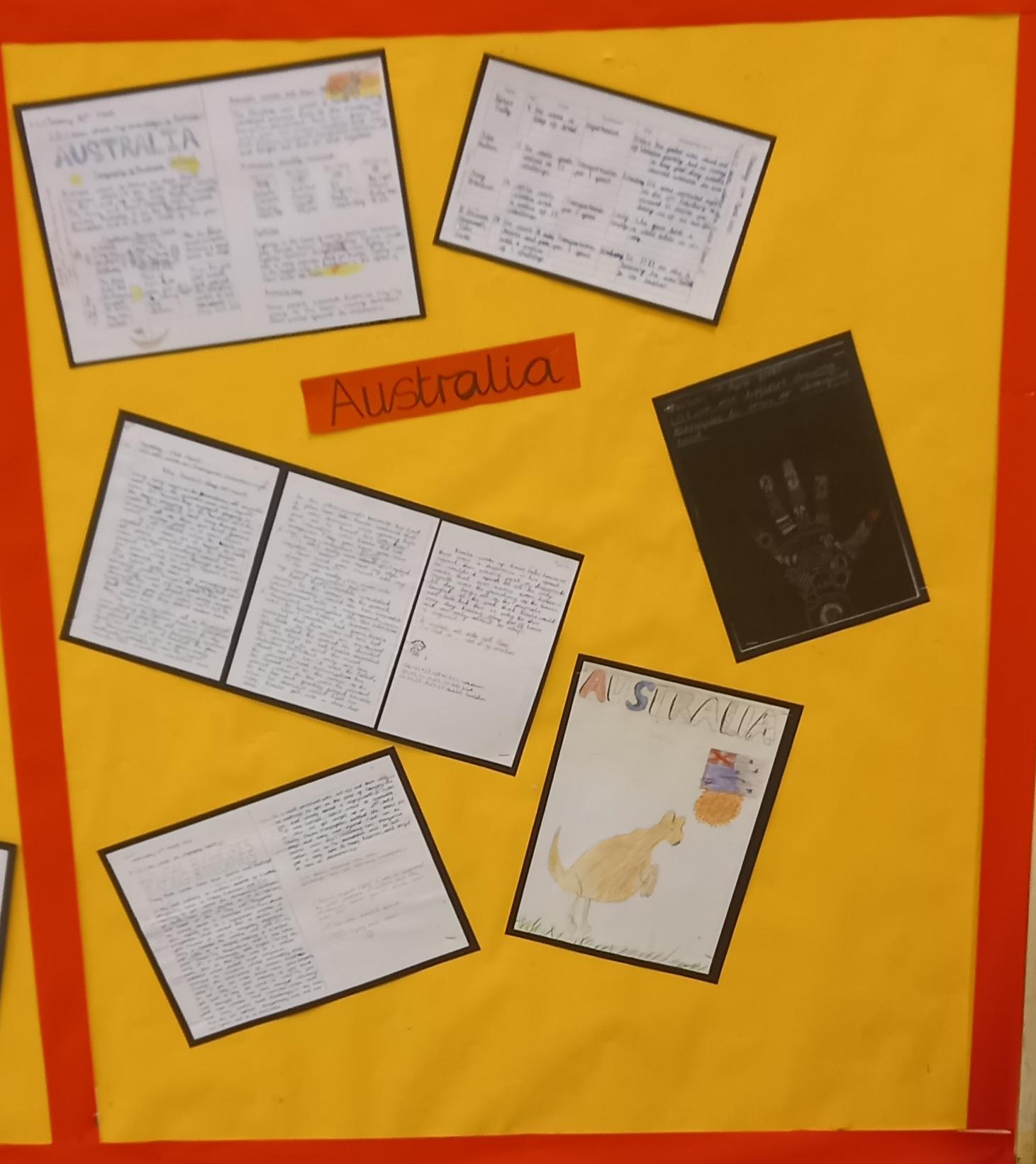
The study of South America offers an in-depth exploration of the continent’s geography, examining its countries, cities, and physical and human features. Through mapping, research, and fieldwork, children will engage with key aspects such as climate, population change, and famous landmarks. This unit encourages the children to explore the relationships between human activity and the environment, linking their learning to global geography. The comparative study of Brazil and the UK allows children to draw connections between different regions, enhancing their understanding of both continents. As part of the inquiry-based approach, children will develop critical thinking skills and a deeper awareness of the world’s geographical diversity.
|
School Learning Zone -South America |
|
School Learning Zone - Contrasting Localities - UK and Brazil |
Year 6 Topic Skills and Knowledge

Year 6 Science Skills and Knowledge
Year 6 consolidate their Science Skills, Keeping Healthy and Light. They learn about the circulatory system, the impact of diet and lifestyle, how light travels in straight lines, reflection and shadows. In the spring term, they study Evolution and Inheritance, exploring traits, adaptations, fossils, natural selection and selective breeding. In the summer term, they cover Electricity and Micro Organisms, investigating circuit components, brightness and volume in circuits, and classifying living things including microorganisms.
|
|
Light Learning Outcomes | [pdf 204KB] |
|
|
|
Light Topic Mat | [pdf 194KB] |
|
|
|
Keeping Healthy Learning Outcomes | [pdf 310KB] |
|
|
|
Keeping Healthy Topic Mat | [pdf 287KB] |
|
|
|
Evolution and Inheritance Learning Outcomes | [pdf 288KB] |
|
|
|
Evolution and Inheritance Topic Mat | [pdf 282KB] |
|
|
|
Circuits Learning Outcomes | [pdf 205KB] |
|
|
|
Circuits Topic Mat | [pdf 195KB] |
|
|
|
Micro-Organisms Learning Outcomes | [pdf 223KB] |
|
|
|
Micro-Organisms Topic Mat | [pdf 204KB] |
|