
Foreign Languages Intent
All pupils in Key Stage 2 at Knowsley Junior School have the right to learn an additional language, the study of which liberates children from insularity and provides an opening to other cultures. Modern foreign language lessons in French give children opportunities to express their ideas and thoughts in another language and to understand and respond to its speakers, both verbally and in writing. They also provide opportunities to read age-appropriate literature and learn songs in the target language.
Ultimately, languages lessons at Knowsley aim to provide a firm foundation for further language learning. They equip children with the skills that they need in order to become life-long language learners, both for the pleasure that can be derived from doing so, and for the practical purpose of equipping pupils to study and work in other countries.
We teach a curriculum that enables our pupils to become effective users of language and show an understanding and respect of different cultures in our local, national and global communities. Through the teaching of high-quality French lessons at Knowsley Junior School, we aim to:
-
Ensure that each child in Key Stage 2 has the opportunity to study French as a foreign language over four years, fostering their interest in the culture of France and the Francophone world.
-
Teach vocabulary and linguistic structures informed by the National Curriculum and the skills expressed therein: listening, speaking, reading and writing (as well as cultural understanding).
-
Enable children to ask and answer a range of questions about themselves, which would allow them to confidently address a French speaker and exchange simple, personal information.
-
Create opportunities for children to manipulate language for their own purposes, drawing on their knowledge of increasingly complex sentence structures.
-
Teach children the basics of phonics in French to allow them to spell in a phonetically plausible way and read and speak with increased confidence and improved pronunciation.
-
Enable children to draw comparisons between French and English vocabulary, using their knowledge of cognates and near-cognates to decode unfamiliar texts of increasing complexity.
-
Encourage children to draw comparisons between French and English grammar, syntax and sentence structure, both as a tool for developing their understanding of the French language and their understanding of English.
-
Give children opportunities to make, and learn from, mistakes in the target language, thereby building resilience.
-
Develop children’s understanding of French as a global language, and the reasons why it is spoken in countries other than France.
-
Enable children to understand their place in the wider world and the concept of interdependence.

Foreign Languages Curriculum Map
Please select the document below.
Implementation: Languages Skills and Knowledge
French is taught by a French specialist. The current programme of study has been developed by previous MFL specialist teachers, ensuring coverage of reading, writing, speaking and listening and building in opportunities for children to revisit knowledge at varying degrees of complexity at a variety of points throughout the four years of study. The long term plans are topic based and phonics, grammar and vocabulary are the key pillars of learning, which are taught in each lesson. The skills and knowledge progression documentation is available on the website.
Lessons taken from the Lightbulb Languages scheme are intended to be active and highly focused, with children working as a whole class, in small groups, or in mixed-ability pairs to complete tasks at their individual level. Work is adapted in a variety of ways to accommodate children in the same class who are all at different stages of their language-learning journeys. Activities consist of games, stories, songs, phonics, grammar and sentence-building activities, rhymes, role-play and dictionary work, to name but a few. The website has a link to games, which can be used as additional resources to support learning at home. Lessons, of approximately one hour in length, happen weekly.
Themed days, including European Day of languages in September and ‘le 14 juillet’ (Bastille Day), offer children opportunities to focus on particular aspects of the culture of France and the French-speaking world, as well as other languages and countries and to use their language in a real-life context.
In addition, a language club has been running since 2022 to encourage children to use Duolingo to access language learning. Pen pals with a school in France began in November 2021 and is ongoing encouraging the children to exchange letters with French pen pals. Links have also been made with local High schools, where their language leaders have led lessons in German, Italian and Spanish at Knowsley Junior School.

|
Languages Skills and Knowledge - Yr3-6 | [pdf 53KB] |

|
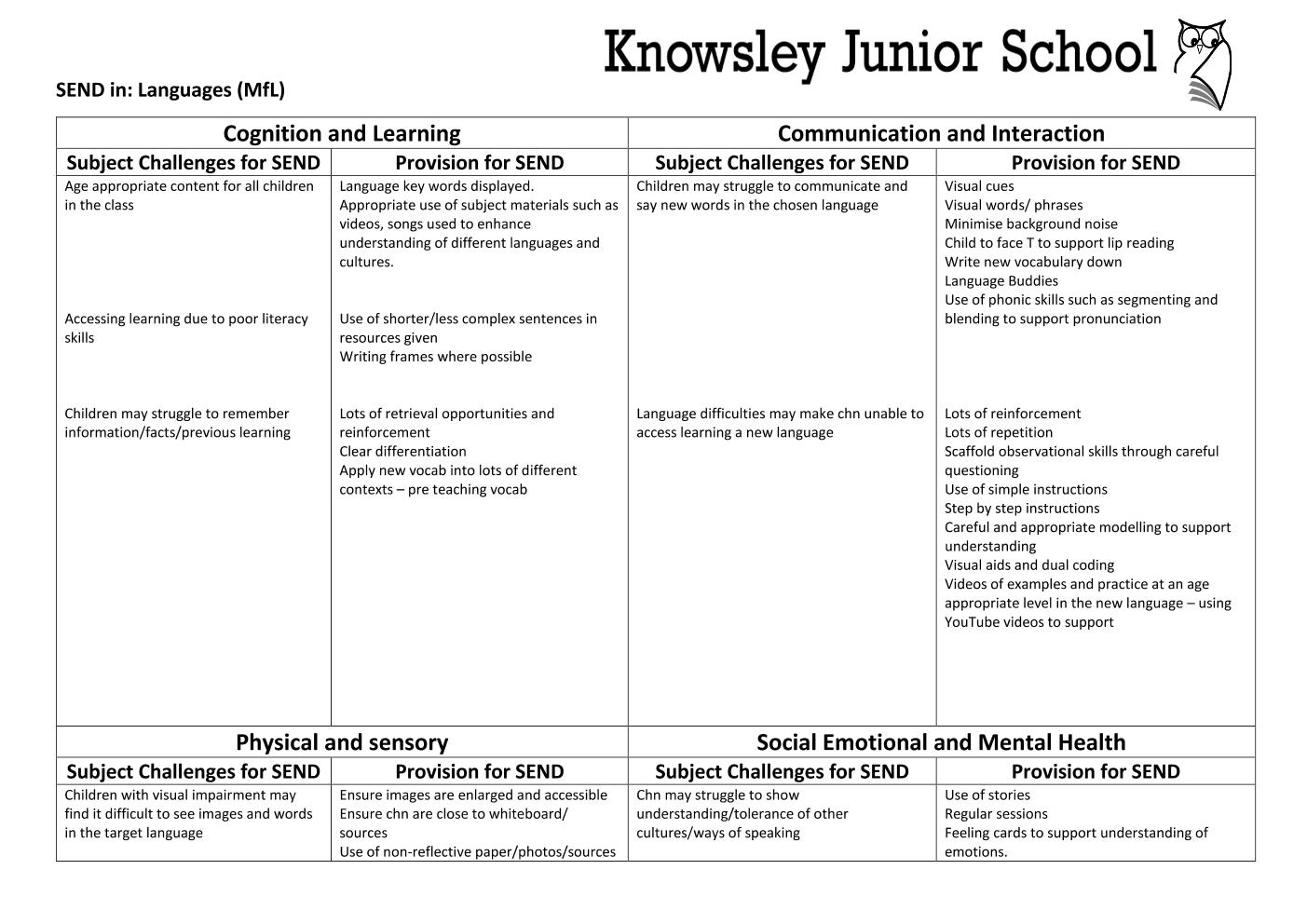
Special Educational Needs: Foreign Languages
Please select the document below.
Impact
Formative assessment is used during French lessons to ensure progress over time. Data, which is gathered termly, is recorded to demonstrate working below, at or above age-related expectations, as well as to identify gaps in knowledge in order to inform the planning of future lessons and units. See French position statement for more detail.
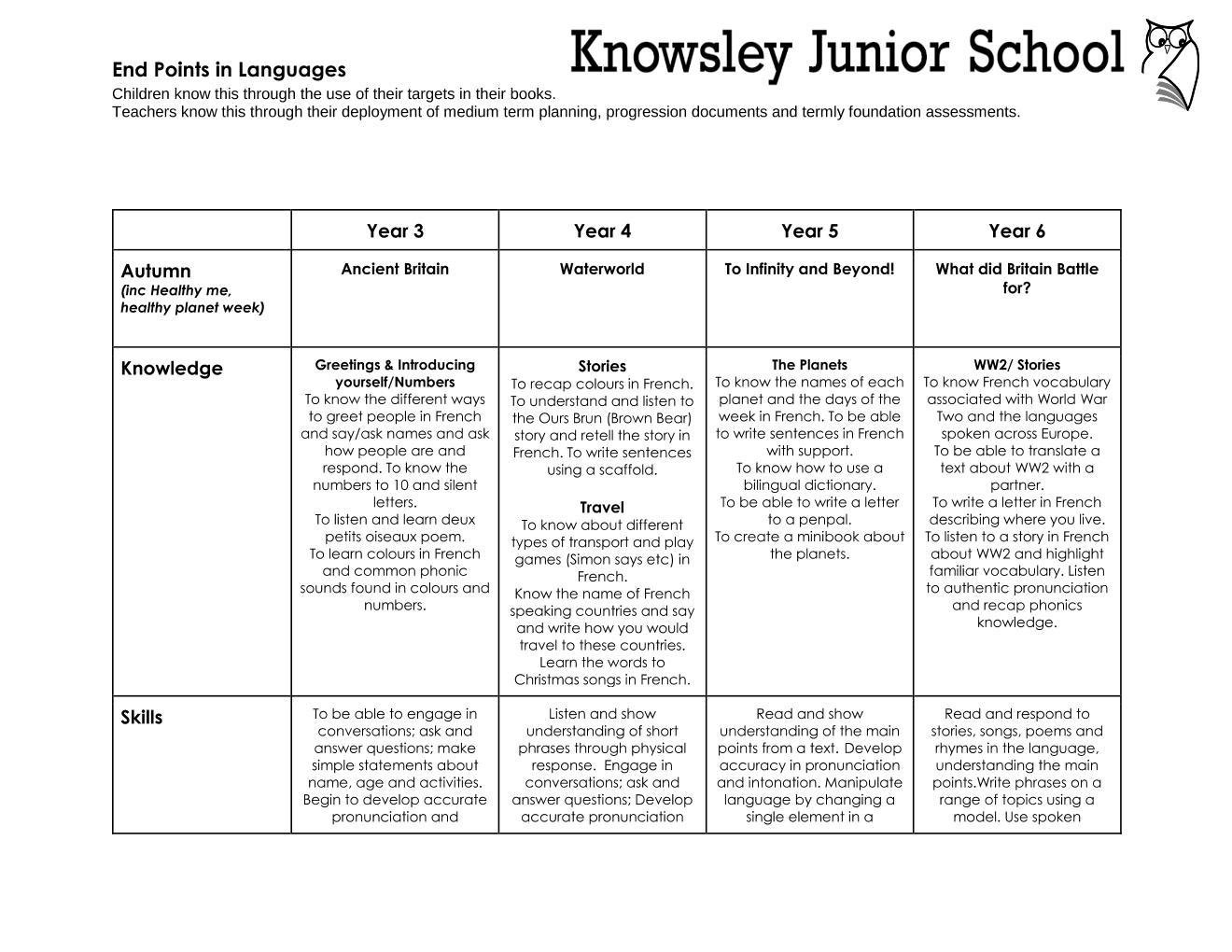
How we know that progress is being made?
Please select the document below.

National Curriculum Foreign Languages
 |
The National Curriculum KS2 Foreign Languages Programme |

Foreign Languages Learning Resources
|
Foreign Language - French Learning Resources |