
Maths Intent
Our intent for mathematics is to teach a rich, balanced and progressive curriculum using maths to reason, problem solve and develop fluent conceptual understanding in each area. Our curriculum allows children to better make sense of the world around them by making connections between mathematics and everyday life. The structure of the mathematics curriculum (following White Rose) across school shows clear progression in line with age related expectations. Teaching curriculum content in blocks allows children to explore skills and knowledge in depth and gain a secure understanding of particular subject matter. Key knowledge and skills are also revisited regularly allowing repetition to embed learning. A concrete, pictorial, abstract approach provides children with a clear structure in which they can develop their depth of understanding of mathematical concepts. We aim to ensure that mathematics is a high profile subject which children view positively and with a ‘Can do’ attitude
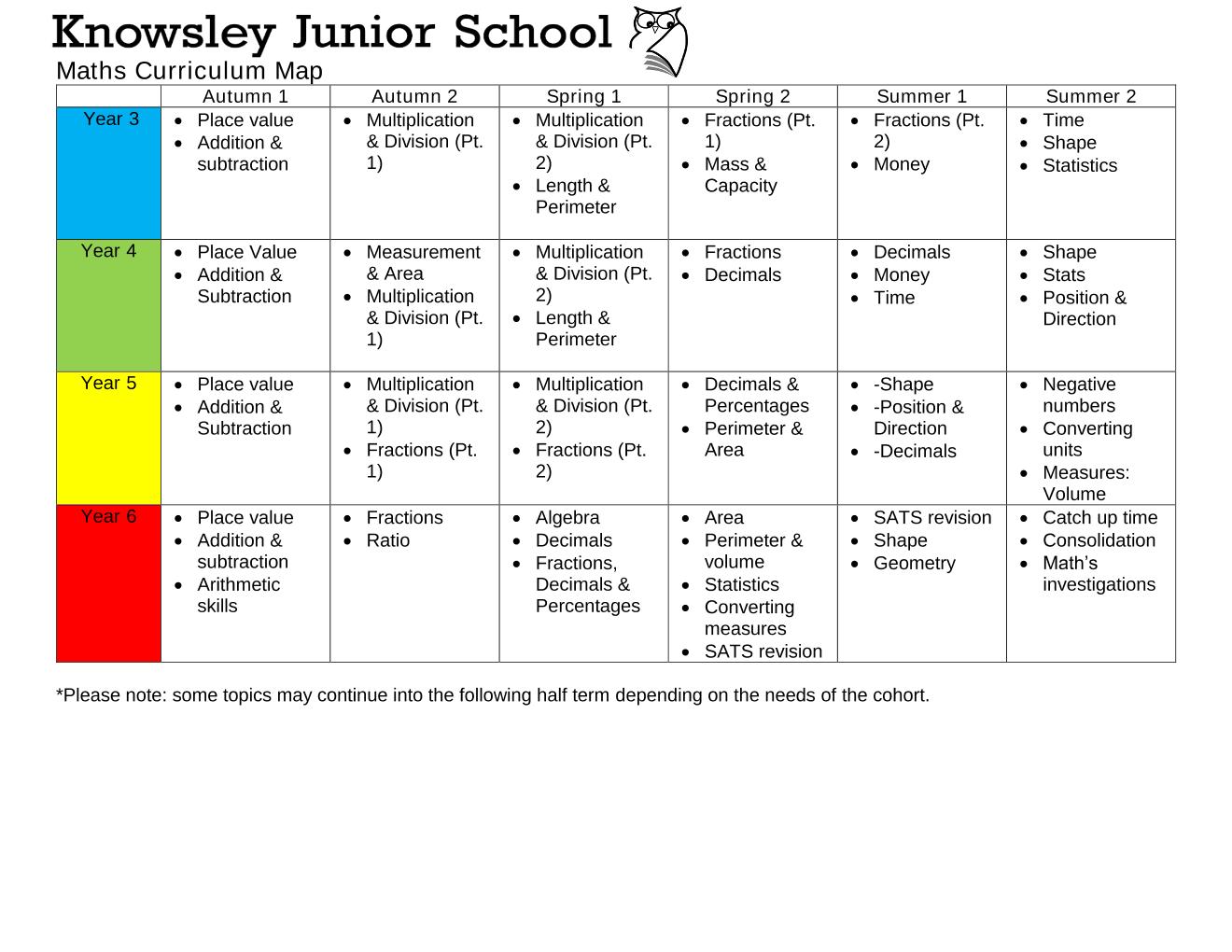
Maths Curriculum Map and Calculation Policy
Please select from the documents below.
Implementation: Maths Skills and Knowledge
-
Medium term planning has been provided to teachers, with a teaching sequence for each week, which allows for more preparation (following White Rose).
-
Teachers differentiate each maths lesson, in order to include all children, and where possible, encourage children to choose the level of challenge for themselves.
-
Deeper learning and greater depth is embedded into teacher’s planning and teaching.
-
Cross-curricular plans mean that maths can be seen in topic books and learning objectives. This ensures that children do not see maths in isolation.
-
Arithmetic is delivered weekly throughout school, using the same format (Rising Stars scheme).
-
We recognise that effective and quality feedback (both verbal and written) provides pupils with valuable information for next steps in learning. This is tracked by the maths coordinators and SLT, using book scrutinies.
-
Teacher assessments, against age-related expectations, are used to track progression. Assessment weeks are used to form overall judgements about attainment and progress through a combination of formal tests (using Rising Stars scheme throughout school) and ongoing teacher assessments. Progress and attainment is recorded against national curriculum age-related expectations using a 7 point system.
-
The PIVATs scheme is used for children who are working below their age-related expectations.

|
Maths Skills & Knowledge in Year 3 | [pdf 357KB] |

|
|
|
Maths Skills & Knowledge in Year 4 | [pdf 175KB] |
|
|
|
Maths Skills & Knowledge in Year 5 | [pdf 247KB] |
|
|
|
Maths Skills & Knowledge in Year 6 | [pdf 243KB] |
|
Impact
-
Progress is measured through the consolidation of learning through greater depth and deeper learning. Children should be developing a breadth of knowledge and deeper learning. They should also be able to apply skills throughout a range of contexts and do this confidently.
-
Progress should also be measured in terms of a child’s confidence in the subject, which is evident during formal and informal observations, and through the children’s enthusiasm for the subject.
-
Each term, teachers report on individual age-related expectations and progress based on their assessments.
-
Progress is tracked through school using the starting points of both KS1 SATs and a Year 3 standardised baseline assessment, which is validated by an external assessor.
-
Data is analysed by the maths coordinator, who reports on the progress of individual pupils, as well as vulnerable groups and groups of children identified in the SDP.
-
Analyses of assessments are shared with individual teachers, year groups and SLT.
-
Children, who are working below the age-related expectations for their year group, are assessed using PIVATS, which is also used to set targets. The SENDCo regularly tracks the progress of all children with SEND.
-
Moderation in year groups is effective because % is broadly in line.
-
Moderation externally with other schools show our measures to be robust


Maths Learning Resources
 |
Maths Learning Resources |