

Our Team 2026-27
Teachers: Mrs J. Bunn, Mrs H. Hewitt, Mrs B. Scott and Miss A. Aldred
Teaching Assistant: Mrs T. Dearden
Class Governor: Karen Cooper-Wilson and Kelsie Akram
Welcome to Year 4
Dear Parent/Guardian,
Welcome to Year 4! We are looking forward to an exciting year filled with new experiences, opportunities to learn and plenty of adventures along the way. Throughout the year, we will encourage the children to become increasingly independent, responsible and confident learners, whilst developing our school values of kindness, honesty, respect, responsibility and resilience.
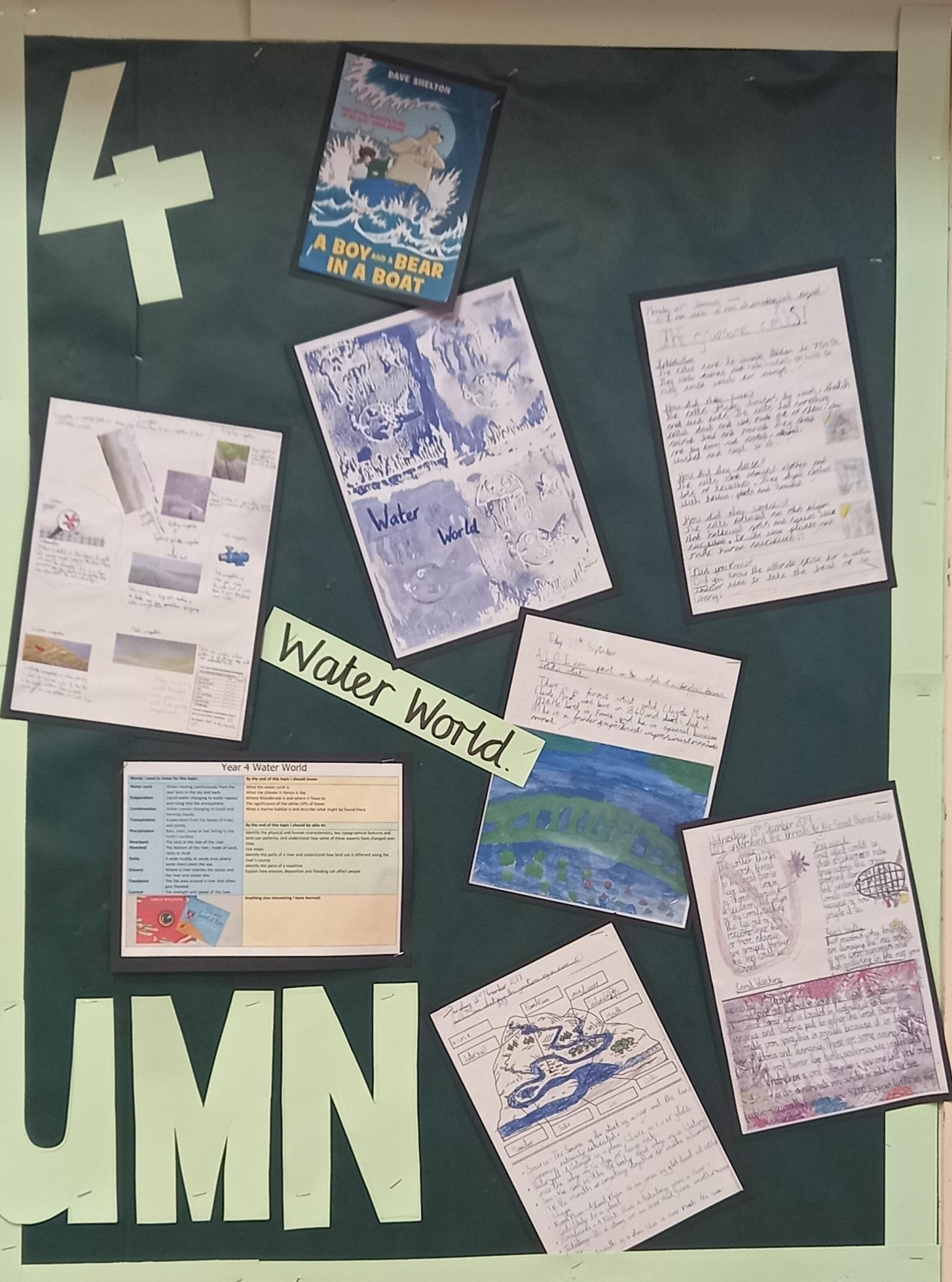
In the Autumn Term, we dive into our ‘Water World’ topic. The children will explore the importance of water and consider how we can use and conserve this precious resource. We will discover the different oceans and seas around the world and learn about the fascinating creatures that inhabit them. The children will also investigate the water cycle and develop their understanding of why water is essential for all life on Earth.
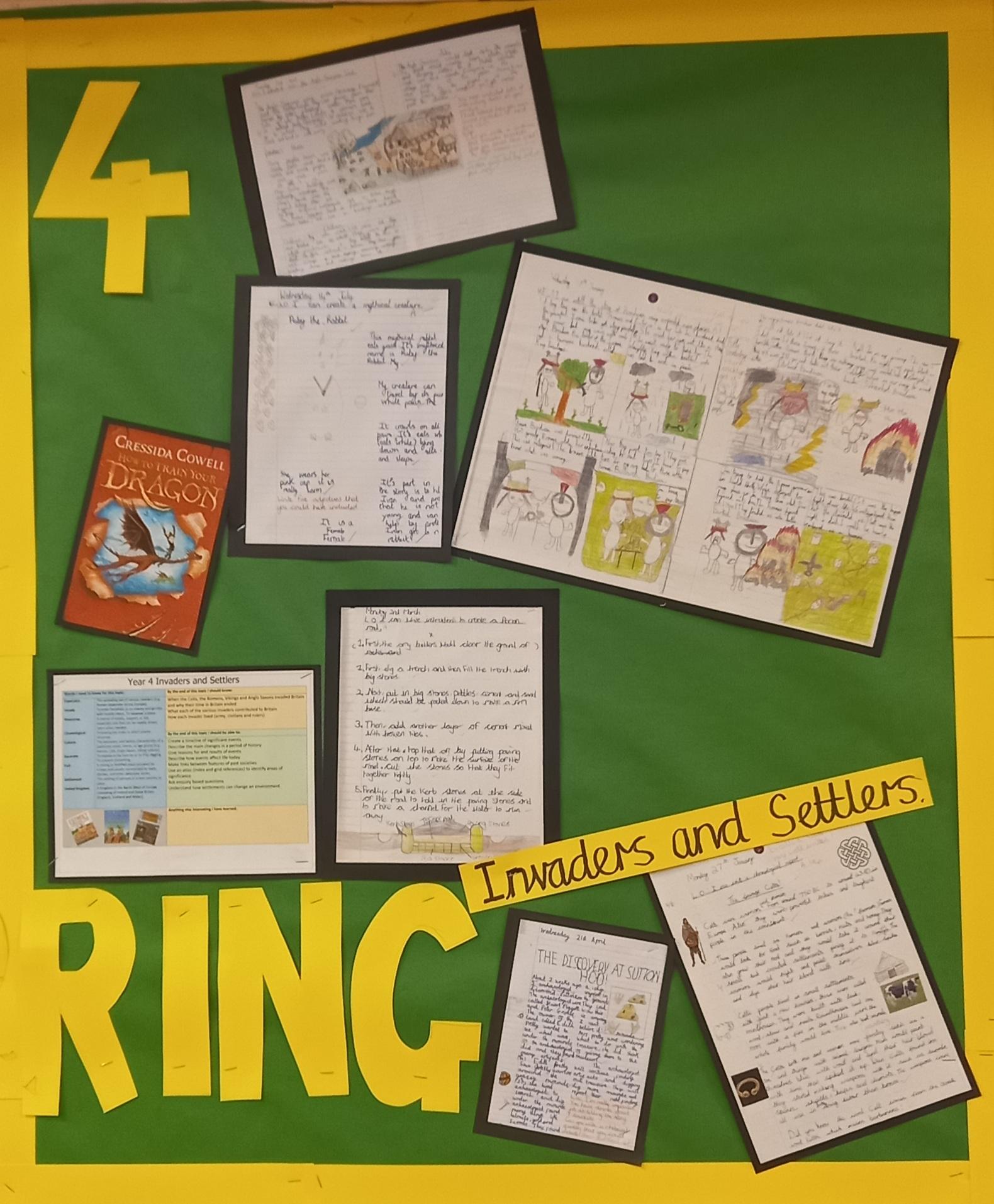
During the Spring Term, we travel back in time to explore ‘Invaders and Settlers’. The children will learn about the Celts, Romans, Anglo-Saxons and Vikings, developing their understanding of how these groups shaped Britain and left their mark on our history. We will explore what life was like during these different periods and investigate the evidence they left behind. The children will also have the opportunity to take part in a special Viking Day in school, supported by a visiting expert, bringing their learning to life through an immersive experience. .
In the Summer Term, we will be exploring ‘To Russia with Love’. Through our geography and history learning, the children will investigate the similarities and differences between Russia and Britain, exploring landscapes, climate, settlements and ways of life. We will also learn more about Russian culture, heritage and history, as well as exploring the work of famous Russian artists and using their ideas to inspire our own creative work.
We will also visit Castleshaw, where the children will develop their understanding of either the journey of a river or the Roman fort and its significance, depending on our focus for the visit
Swimming is another exciting part of the Year 4 journey and an important element of our PE curriculum. Once a week, the children will travel to Saddleworth Swimming Baths for their swimming lesson, where they will develop their water confidence, swimming skills and knowledge of water safety.
We are excited about all that Year 4 has to offer and look forward to seeing the children grow in confidence, independence and resilience throughout the year. We hope they enjoy every challenge, discovery and adventure along the way!
Here’s to a fantastic year of learning and new experiences!
Your Year 4 Teachers

Welcome to Year 4
Please select the document below.

|
Welcome to Year 4 Presentation September 2026 | [pdf 769KB] |

|


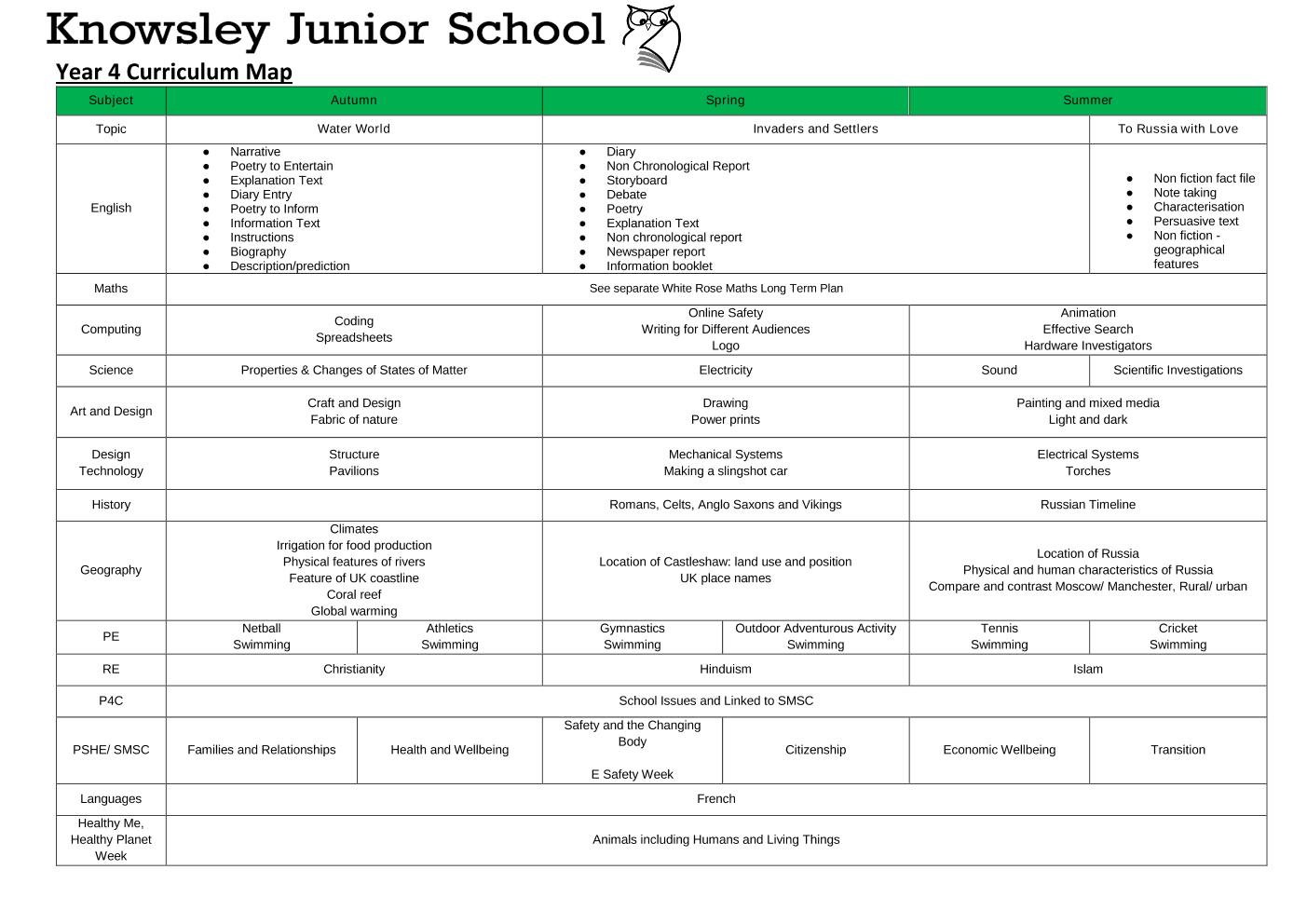
Annual Curriculum Planning
Please select the document below.
|
|
Year 4 Curriculum Map | [pdf 351KB] |
|
Autumn Term First Half 2026

Autumn Term Second Half 2026
TBA

Autumn Term Home Learning Challenges
At Knowsley Junior School, we know that children achieve their best when home and school work together. This year, we have developed our approach to home learning, informed by research from the Education Endowment Foundation (EEF).
Our home learning activities are designed to be purposeful, manageable and enjoyable, reinforcing classroom learning, encouraging regular reading and helping children practise key skills. We encourage children to complete activities little and often, developing their confidence, independence and positive learning habits.
Please encourage your child to take part and use their school planner to record, share and celebrate their learning at home.
Learning happens everywhere. By working together, we can help our children develop the knowledge, skills and confidence to thrive.

Reading Home Learning Challenges
- Reading Detective – after reading, choose a character and find evidence in the text to explain what they are like. Can you find three clues that tell you about their personality, feelings or behaviour?
- Book Club at Home – choose a book and read some together. Discuss the characters, themes and interesting vocabulary. What predictions can you make about what might happen next? Enjoy a drink and some biscuits together too!
- Non-Fiction Explorer – read a newspaper article, biography, information book or science magazine. Share three things you have learned, one thing that surprised you and one question you still have.
- Vocabulary Collector – collect five interesting or unfamiliar words from your reading. Find out what they mean, identify whether they are a noun, verb, adjective or adverb, and use each word in your own sentence.
- Author Challenge – find out about the author of a book you have enjoyed. What other books have they written? Can you find out something interesting about their life or what inspired them to write?
Writing and Spelling Home Learning Challenges
- Year 3/4 Spelling Challenge – practise 5–10 Year 3 and Year 4 statutory spelling words. Can you explain their meanings, use them in sentences and find another word with a similar meaning?
- Word Detective – choose an interesting word from your reading. Find out its meaning, synonyms and antonyms. Can you create a sentence using the word correctly?
- Weekly Journal – write about something you have enjoyed, learned, wondered about or achieved during the week. Try to include interesting vocabulary, different sentence openers and accurate punctuation.
- Proofreading Challenge – choose a piece of your own writing and become a proofreading detective. Check your spelling, punctuation, grammar, sentence structure and vocabulary. Make at least three improvements.
- Picture Prompt – find an interesting photograph or picture. Write a short description or story inspired by it. Can you include expanded noun phrases, fronted adverbials and ambitious vocabulary?
Maths Home Learning Challenges
- Times Tables Rockstar – use TT Rock Stars regularly to improve the speed and accuracy of your multiplication and division facts. Challenge yourself to beat your previous score!
- Calculation Challenge – practise the formal written methods for addition, subtraction, multiplication and division. Can you check your answer using the inverse operation?
- Fractions in Real Life – look for fractions around your home. Can you find fractions in recipes, clocks, measuring, sharing food or objects? Challenge yourself to identify equivalent fractions.
- Problem-Solving Challenge – create your own maths problem for someone else to solve. Can you make it challenging enough to require more than one step?
- Place Value Detective – choose a 4-digit number. Write it in words and expanded form. What is the value of each digit? Can you make the greatest and smallest number using the same four digits?
- Games with Maths – play a game involving numbers, money, coordinates, strategy or problem-solving, such as Monopoly, Battleships, cards or a number game.
Personal Development Home Learning Challenges
- Stay Safe Online – create a poster, leaflet or short guide explaining how children can stay safe online. Include advice about passwords, personal information, chatting online and what to do if something makes you feel worried or uncomfortable.
- Healthy Choices – keep a record of some of the food and drinks you have over two days. Think about how you can make healthy choices and maintain a balanced diet. Can you identify different food groups?
- Kindness Challenge – carry out an act of kindness for someone at home, at school or in your community. Write about what you did, how it made someone feel and how it made you feel.
- Ready, Respectful, Safe – choose one of our school behaviours and show how you have demonstrated it at home. Can you give a real example of how you have been Ready, Respectful or Safe?
- Resilience Challenge – have a go at something that you find difficult. It could be learning a new skill, completing a tricky puzzle, trying a new activity or practising something you are not yet confident with. What did you do when it became difficult?

Waterworld
The first topic children encounter in year 4 is centred around the water cycle. The importance of water for life was established in What is Underneath our Feet? in year 3. Their knowledge of the geography of Britain is deepened when examining river locations and erosion at places such as Dover and Dorset. In year 2, children compare England with Africa, and they acquire more knowledge of the continent through the text Lila and the Secret of Rain in year 4. In addition to the work on the importance of rivers, irrigation in Africa is studied; valuable for the understanding of Ancient Egypt in year 5 and the rise of society around the Nile.
 |
School Learning Zone - Rivers |
|
School Learning Zone - The Water Cycle |
|
School Learning Zone - Under the Sea |

Invaders and Settlers
This topic follows the chronological history of Britain and combines both in depth and overview study of the Romans, Anglo Saxons, Scots and Vikings. It allows children to make connections, contrasts and note trends over time. The myths examined from across the societies are familiar due to the examination of such narratives in year 3. Locational knowledge of British counties is extended via the discussion of historical place names’ and the discovery of Oldham being an Old Norse name. At the beginning of the Spring term, our additional close proximity to the Roman Fort at Castleshaw provides children with a deeper knowledge and awareness of the history of Oldham. Children will develop an appreciation of a wide range of cultural influences and can compare the legacy of the Ancient Greeks to that of the Romans and Vikings and debate which has had the most impact in their lives. The Roman Empire is revisited when learning about Cleopatra in year 5, providing children with the opportunity to appreciate the full scale of the realm and support their chronological understanding

To Russia with Love
This geography driven topic allows children to compare and contrast a modern day European country and city with their own. They are introduced to climates and discuss the issues between urban and rural life. This provides a foundation for climate and biome work in year 5. Music and art form the secondary drivers, through which children examine two historically important individuals – Kandinsky and Stravinksy. Children will study composers and artists throughout their curriculum journey, and this provides an opportunity to examine such people more thoroughly.
|
School Learning Zone - Climate and Biomes |
|
School Learning Zone - Contrasting Localities |
|
School Learning Zone - Wassily Kandinsky |
|
School Learning Zone - Composers |
Year 4 Topic Skills and Knowledge
- Waterworld Learning Outcomes [pdf 210KB]
- Waterworlds Skills and Knowledge Mat [pdf 235KB]
- Invaders and Settlers Learning Outcomes [pdf 209KB]
- Invaders and Settlers Skills and Knowledge Mat [pdf 230KB]
- To Russia with Love Learning Outcomes [pdf 212KB]
- To Russia with Love Skills and Knowledge Mat [pdf 239KB]

Year 4 Science Skills and Knowledge
Year 4 also start with Developing our Science Skills, Teeth and Eating, Habitats and States of Matter. They learn about the digestive system, teeth functions, food chains, grouping living things, and changes of state including evaporation and condensation. In the spring term, they study Sound, exploring how sounds are made by vibrations, pitch, volume, and how sound travels. In the summer term, they cover Electricity, constructing simple circuits, identifying components, and learning about conductors and insulators.
|
|
Properties of Materials Learning Outcomes | [pdf 222KB] |
|
|
|
Properties of Materials Topic Mat | [pdf 201KB] |
|
|
|
States of Matter Learning Outcomes | [pdf 304KB] |
|
|
|
States of Matter Topic Mat | [pdf 281KB] |
|
|
|
Teeth and Eating Learning Outcomes | [pdf 205KB] |
|
|
|
Teeth and Eating Topic Mat | [pdf 198KB] |
|
|
|
Habitats Learning Outcomes | [pdf 205KB] |
|
|
|
Habitats Topic Mat | [pdf 200KB] |
|
|
|
Electricity Learning Outcomes | [pdf 223KB] |
|
|
|
ElectricityTopic Mat | [pdf 194KB] |
|
|
|
Sound Learning Outcomes | [pdf 205KB] |
|
|
|
Sound Topic Mat | [pdf 194KB] |
|